Navigation
Related Links
Cairns Reef Tours
Cairns Connect lists a number of reef and island tours departing Cairns
Cairns Fishing Tours
Cairns Connect lists a number of fishing tours departing Cairns
Tours To Go
Tours To Go lists dozens of Cairns fishing tour operators
Environmental Issues — Cairns, North Queensland, Australia

Environmental Issues facing the Cairns Esplanade
Tropical North Queensland has been a centre for furious and lengthy environmental battles for many decades. Development of infrastructure and roads in the Daintree Rainforest, fertilizer run-off and human activity at the Great Barrier Reef, construction of the Skyrail cableway through rainforest at Smithfield, development of a resort and marina at the Hinchinbrook channel, marina proposals at Mission Beach, the attempted damming of the Millstream River — the list goes on and on.
Even the Cairns Esplanade has been a part of the action. In 1989, 6000 people protested against the ‘Trinity Point’ development, which proposed a hotel and tourist facility on the esplanade mudflats. A major campaign, led by Cairns doctor Michael Mansfield, was launched to put a stop to the development. The swell of local dissent with the proposal enticed the Queensland Labor government to withdraw consent for the development shortly after it was elected in late 1989. It seemed the Cairns Esplanade was safe.
But the people of Cairns have changed their opinions about the Esplanade in recent years. Instead of perceiving it as a unique environmental habitat for thousands of animals, it has become an eyesore that damages the reputation of the city and hinders tourism. No major campaigns were launched in protest to Cairns City Council proposals to develop the site, and the Cairns people have backed their council despite the inconvenience of a lengthy construction phase in the city centre.
Environmental Impact of the foreshore development

The Cairns Esplanade is an internationally recognised migratory water bird habitat and is a declared fish habitat area. It is adjacent to a declared Fish Habitat Area, the Trinity Inlet/Marlin Coast Marine Park, the Great Barrier Reef World Heritage Area, and is an important bird roosting site for Whimbrel on their southern migration. Despite this, 160,000 cubic metres of sand and a 4000m2 concrete slab has been laid on the mud as a base for the Esplanade swimming lagoon, and a man-made beach has been constructed at one end of the mudflats. However, all planning and building has been carried out in an environmentally sensitive way, and construction companies involved with the project have followed strict regulations. The Cairns City Council adopted a philosophy of “no net environmental impact” for the esplanade. That means that any environmentally detrimental impact is compensated by an equal or greater beneficial impact.
An example taken from the Cairns City Council website claims, “For instance the loss of water bird habitat in the area that has been reclaimed, is to be compensated by undertaking a long-term monitoring program and by increasing awareness of the international significance of migratory waders through interpretive signage, etc.”
The importance of environmental issues on the site was recognised from the inception of the project, particularly the bird life, which attracts visitors from around the world. Prior to the appointment of any of the design team, a bird specialist was contracted to report on existing environmental values and to identify opportunities to minimise developmental impact.
The outcome was that rather than being threatened by the development, the bird life is intended to become one of its most important attractions. Key environmental issues were identified in the initial public consultation stage and incorporated into the design brief.
To compensate for any impact on tidal wildlife, the project managers have endeavoured to:
- Provide an environmental interpretation centre and playground where tourists and locals can learn about the tropical ecosystems in an informative and interactive interpretation of the waterfront ecosystem.
- Build a wide waterfront boardwalk to create pedestrian access and maintain a “soft” human footprint.
- Limit construction to the least productive area of mudflats — that is, the southern end near the Pier.
Environmental Impact Assessment
An Environmental Impact Assessment has been undertaken to assess potential impacts and to develop mitigation strategies. The study found that the long-term impact of the development would be positive. The construction phase had some negative impacts, such as noise and dust, but this is expected of any development project.
Environmentalists, however, are not entirely happy with the impact statement. They say flaws are apparent and the statement contravenes the spirit of the Trinity Inlet Management Plan because it ignores the No Net Loss of habitat concept, and the Precautionary Principle. (This is a concept that says proposals should always look for alternatives if any environmental impact could result.) Opponents to the development also say the statement simply assumes that inshore wading birds will be able to find other places to go.
What happens now?
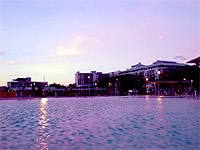
Whether you like it or not, the Cairns Esplanade is being developed. A section of tidal mudflats has been buried under concrete and some migratory birds will need to find somewhere else to live. But we need to be aware that construction has been conducted in a sensitive way, and detailed analysis has been performed about the impact of the changes to the foreshore. The economic benefits stemming from the project will be a boon for Tropical North Queensland, and tourists will have access to world-class beach facilities within walking distance of their accommodation.